
Flexible Emissions Control Solutions for Industrial Combustion Sources
Market Overview
Manufacturing and industrial facilities rely on combustion for a wide array of process functions — steam generation, direct-fired heating, thermal oxidation of waste streams, and on-site power generation. Across these applications, NOx emissions are a significant regulatory concern, particularly in manufacturing-dense regions subject to ozone nonattainment designations and tightening state implementation plans.
Unlike utility power generation, industrial and manufacturing facilities present a diverse mix of equipment types, fuel compositions, thermal loads, and operating schedules. This variability demands a flexible engineering approach and experience across multiple combustion application types.
The NOx Challenge
Industrial combustion sources face NOx compliance challenges that vary widely by process. Package boilers cycling with steam demand, process heaters operating at precise temperature profiles, thermal oxidizers destroying variable-composition waste gas streams — each presents different exhaust conditions that must be characterized accurately to design an effective emissions control system. Many industrial sites also operate under site-wide emission caps or facility-level operating permits that require careful coordination of individual source limits.
Target Equipment
- Package boilers and process steam generators
- Direct-fired process heaters, ovens, and kilns
- Thermal oxidizers and regenerative thermal oxidizers (RTOs)
- Combined heat and power (CHP) and cogeneration systems
- Industrial gas turbines and reciprocating engine generator sets
- Combustion air preheaters and recuperators
- Dryers and other direct-fired process equipment
Regulatory Landscape
| Regulation / Program | Relevance to NOx Control |
|---|---|
| EPA NSPS Db / Dc | Standards for industrial, commercial, and institutional steam generating units — NOx limits based on heat input capacity |
| 40 CFR Part 63 Subpart DDDDD | NESHAP for major source industrial boilers — NOx and HAP emission standards |
| 40 CFR Part 63 Subpart JJJJJJ | Area source boiler MACT — applies to smaller industrial and commercial boilers |
| State & Local Air District Rules | Industrial NOx RACT rules, facility operating permits, and regional air district regulations frequently exceed federal standards |
| Title V Operating Permits | Major source facilities are subject to comprehensive operating permits with federally enforceable NOx emission limits |
How EcoCAT Systems Helps
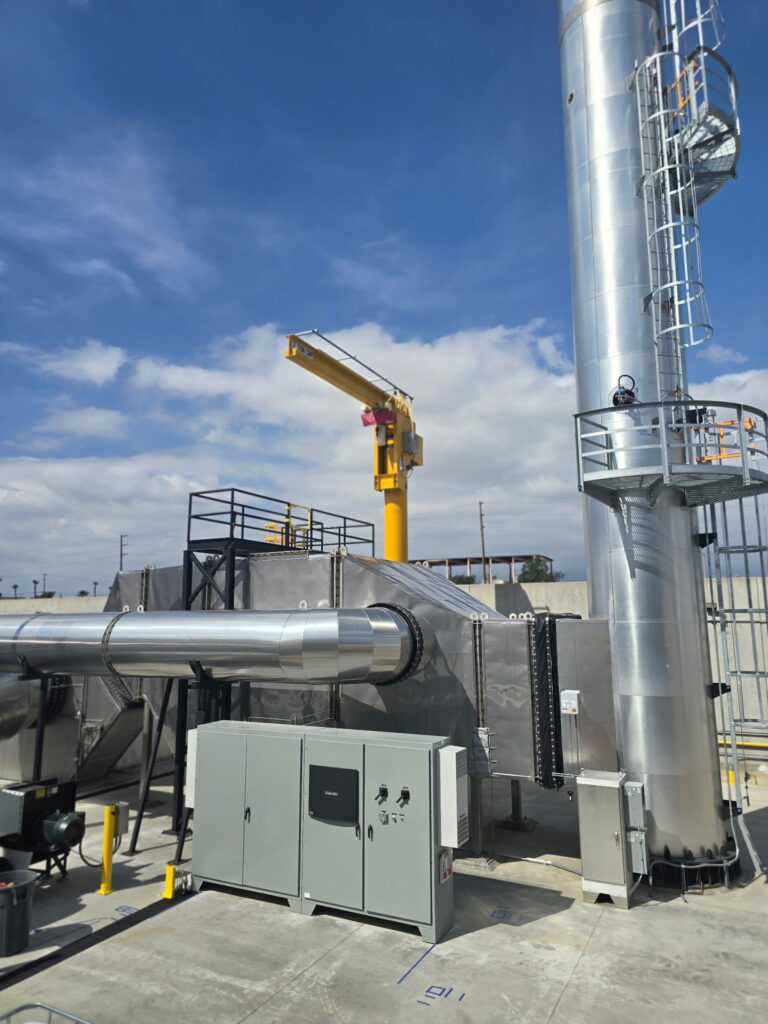
EcoCAT Systems has experience in engineering emissions control systems for diverse industrial combustion applications. Our in-house engineering team performs the process characterization, system sizing, and detailed design necessary to deliver reliable NOx reduction across variable industrial operating conditions. In addition to SCR and SNCR systems, EcoCAT offers ductwork, dampers, dilution air systems, afterburners, and stack and flue components — enabling us to serve as a single-source solutions provider for complex industrial emissions control projects.
Let’s Find the Right Solution for Your Facility
Every system is different—and the best solution starts with understanding your specific application.
Request a System Evaluation | Talk to an Emissions Specialist | Explore or SCR Solutions