

Data centers are one of the fastest-growing sources of stationary generation in the country — and one of EcoCAT’s most active markets. Whether the application is emergency standby, continuous prime power, or transitional bridge generation, we engineer SCR solutions that meet the permit, perform in the field, and integrate with your power strategy.
Market Overview
The explosive growth of hyperscale and colocation data centers has fundamentally changed the stationary generation landscape. Facilities that once relied solely on diesel emergency generators are now deploying large gas turbine and reciprocating engine assets for prime power and bridge power — driven by grid congestion, interconnection delays, clean energy mandates, and the need for resilience in an increasingly electrified economy.
With this expansion comes heightened air permitting scrutiny. Data center campuses in major markets — Northern Virginia, Phoenix, the Dallas-Fort Worth Metroplex, Silicon Valley, Chicago, and Atlanta — are managing cumulative emissions from hundreds of megawatts of on-site generation across multiple regulatory jurisdictions. Air districts and state agencies are applying BACT/LAER standards to new or expanded permits, and Title V thresholds are regularly triggered by large campuses, bringing federal major source obligations into play.
EcoCAT is actively engaged in this market, providing engineered SCR systems for all three generation modes: emergency standby, prime power, and bridge power. Our team understands the permitting landscape, the equipment involved, and the engineering requirements that distinguish a reliable, compliant data center emissions control system from a catalog solution.ing industry regulations for sustainability and compliance.
Generation Modes — What They Mean for Emissions Control
Emergency Standby Power
Diesel generator sets that operate only during grid outages and mandatory load testing. Typically limited to 500 hours/year under air permits. Tier 4 Final certification is the EPA standard for new CI engines, but older Tier 2 and Tier 3 fleets — and facilities with sub-permit-limit requirements — often require add-on SCR. System design must address cold-start warm-up and infrequent duty cycles.
Prime Power
Continuous or near-continuous on-site generation using gas turbines or natural gas reciprocating engines, operating independently of or in parallel with the grid. Increasingly used at hyperscale data centers where utility interconnection timelines are measured in years, not months. Prime power assets operate under full Title V or major source permit requirements with continuous NOx limits — typically 2–9 ppm for turbines and 0.5–1.0 g/bhp-hr for reciprocating engines. SCR is almost always required.
Bridge Power
Temporary or transitional generation deployed to power a data center campus while permanent utility service or renewable energy infrastructure is being developed. Bridge power assets may operate for 2–5 years before transitioning to grid service or being redeployed. These projects often involve modular or containerized gas turbine or engine packages where SCR must be integrated into a compact, relocatable system design.
Tier 4 Final — What It Is and Where SCR Fits
EPA’s Tier 4 Final emission standard, codified under 40 CFR Part 1039 for mobile and nonroad diesel engines (and referenced in NSPS Subpart IIII for stationary CI engines), establishes the most stringent engine-out NOx and PM limits currently in effect for compression-ignition engines. Tier 4 Final engines use a combination of advanced combustion design, exhaust gas recirculation (EGR), and — critically — aftertreatment systems to achieve compliance.
| Tier Level | NOx = NMHC Limit (g/kW-hr) – Engines ≥ 560 kW |
|---|---|
| Tier 2 | ≤ 6.4 |
| Tier 3 | ≤ 4.0 |
| Tier 4 Interim | ≤ 2.0 |
| Tier 4 Final | ≤ 0.4 |
Tier 4 Final compliance is achieved through Selective Catalytic Reduction built into the engine aftertreatment system — typically a diesel exhaust fluid (DEF/AdBlue®) SCR system paired with a diesel particulate filter (DPF). So in many cases, the engine already has an integrated SCR system from the OEM.
Where EcoCAT Adds Value in a Tier 4 World
Despite Tier 4 Final engine-integrated SCR, data center projects still require external emissions control engineering in several important scenarios:
- Permit limits stricter than Tier 4 engine-out performance — some air districts in California, Colorado, and the Northeast impose NOx limits tighter than what Tier 4 engine aftertreatment alone can achieve, requiring a supplemental or external SCR system.
- Existing Tier 2 and Tier 3 fleet upgrades — large data center operators with legacy generator fleets are increasingly required (or incentivized) to retrofit SCR on older engines to maintain or renew operating permits.
- Natural gas standby and prime power engines — Tier 4 is a diesel standard. Natural gas reciprocating engines and gas turbines used for standby or prime power are regulated under NSPS Subpart JJJJ and KKKK respectively, and require separately engineered SCR systems to meet permit NOx limits.
- Campus-level permit compliance — even where individual engines meet Tier 4, cumulative campus NOx loads under Title V may require additional controls to stay within facility-wide permit caps.
- Bridge power modular packages — containerized or skid-mounted SCR systems for temporary generation assets, designed for rapid deployment and eventual relocation.

Regulatory Environment
Data center emissions permitting is evolving rapidly. The following regulatory frameworks are most commonly encountered:
- EPA NSPS Subpart IIII — Standards of Performance for Stationary Compression Ignition Internal Combustion Engines (diesel generators)
- EPA NSPS Subpart JJJJ — Standards of Performance for Stationary Spark Ignition Internal Combustion Engines (natural gas generators)
- EPA NSPS Subpart KKKK — Standards of Performance for Stationary Combustion Turbines (gas turbines for prime/bridge power)
- NESHAP Subpart ZZZZ — National Emission Standards for Stationary RICE (existing engines at major and area sources)
- State and local BACT/LAER requirements — California air districts (SCAQMD, BAAQMD, SJVAPCD), Virginia DEQ, Texas TCEQ, Arizona DEQ, and others actively applying BACT analyses to new data center permits
- Title V Major Source thresholds — NOx potential to emit (PTE) above 100 TPY (or 25 TPY in serious/severe ozone non-attainment areas) triggers major source obligations
EcoCAT Data Center SCR Solutions
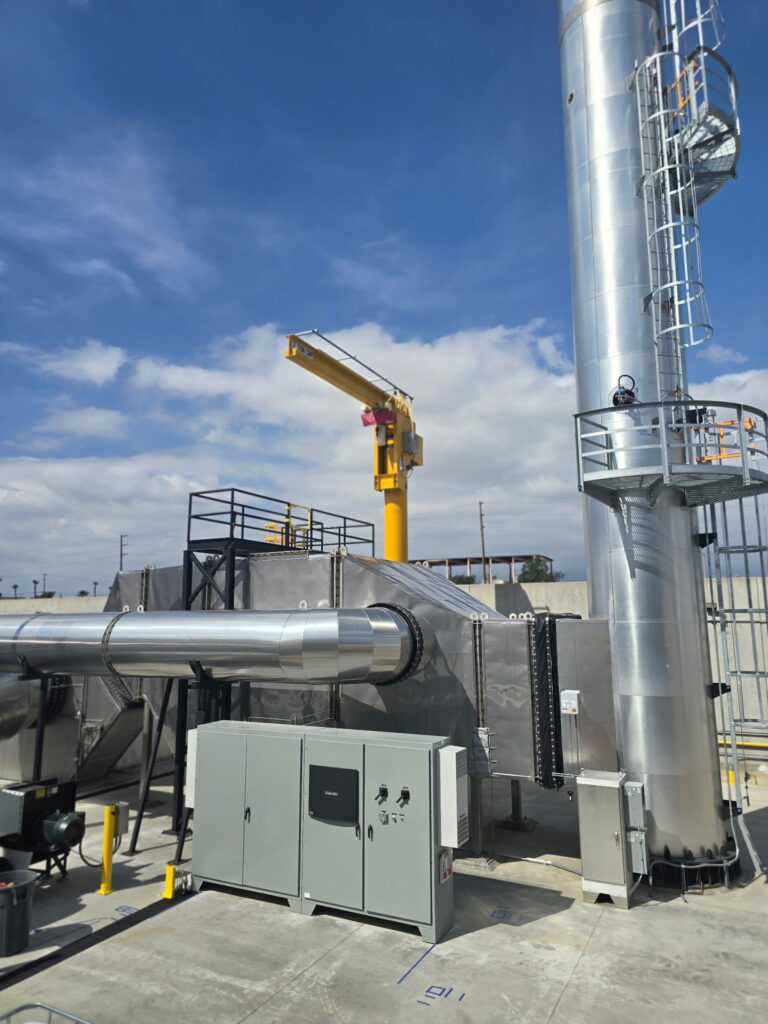
EcoCAT designs and supplies complete SCR systems for all data center generation configurations — from a single diesel standby unit to a multi-megawatt prime power gas turbine installation. Our in-house engineering scope includes reactor sizing, AIG design, AFCU and reagent system, controls integration, and ductwork — engineered as a system to your specific permit conditions and equipment configuration.
- Compact, skid-mounted SCR packages for modular and containerized installations
- Rapid warm-up catalyst designs for cold-start diesel standby applications
- Gas turbine SCR for prime and bridge power installations — 2–9 ppm NOx performance
- Natural gas reciprocating engine SCR — 0.5–1.0 g/bhp-hr and below
- Diesel engine external SCR retrofit for Tier 2/Tier 3 fleet upgrades
- Reagent system design — DEF, aqueous ammonia, or urea — matched to facility infrastructure
- Controls integration with facility SCADA, BMS, and CEMS data acquisition
Why Data Centers Choose EcoCAT
Data center developers and operators choose EcoCAT because we understand both the engineering and the permitting side of the problem. We have experience working with project teams during the design-build phase — providing permit-ready system documentation, performance guarantees, and designs that can be installed and commissioned on aggressive data center construction schedules.
Our broad product portfolio also means we can support the full power generation scope: not just the SCR, but the exhaust ductwork, stack system, dilution air, and controls — reducing the number of vendors on your project and the coordination risk that comes with them.
Ready to Optimize your Operations?
Message our Experts