
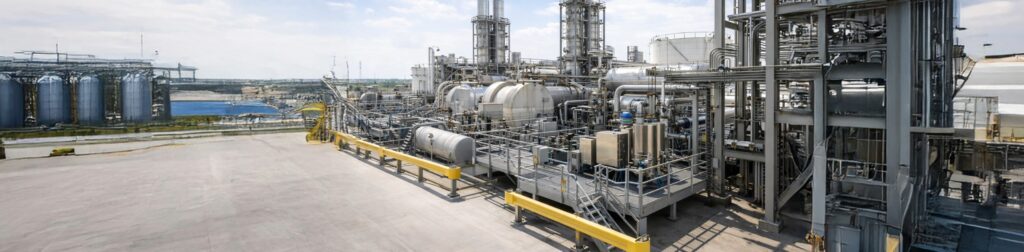
Integrated SCR Systems and HRSG Engineering for Combined Cycle and Cogeneration
Equipment Profile
Heat recovery steam generators (HRSGs) capture thermal energy from gas turbine exhaust to produce steam for power generation (combined cycle) or process use (cogeneration and CHP).
HRSGs range from single-pressure unfired units in smaller industrial CHP applications to complex multi-pressure, supplemental-fired configurations in large combined cycle power plants. The HRSG represents the ideal location for SCR system integration in gas turbine applications — the duct configuration and temperature profile downstream of the turbine exhaust provide an effective environment for catalyst installation and reagent injection.
SCR Integration in HRSGs
SCR catalyst modules are typically installed between the high-pressure evaporator and economizer sections of the HRSG, where exhaust temperatures fall within the optimal catalyst operating window — generally 550°F to 750°F for conventional vanadium-based catalyst, or higher temperature ranges for zeolite-based formulations.
The ammonia injection grid (AIG) is located upstream of the catalyst bed, with sufficient mixing distance to ensure uniform reagent distribution across the full HRSG cross-section.

EcoCAT HRSG Engineering Scope
- Full HRSG design and supply for new combined cycle and cogeneration projects
- SCR catalyst section engineering — catalyst frame, module support structure, and access provisions
- AIG design and fabrication, including flow adjustment provisions for field optimization and tuning
- Duct burner integration for supplemental-fired HRSG applications
- Reagent injection system (RIS) and aqueous or anhydrous ammonia skid supply
- Ammonia flow control unit (AFCU) for urea-to-ammonia conversion applications
- Stack and flue design with CEMS port provisions
- Controls integration with turbine controls and plant DCS
Supplemental Firing Considerations
HRSGs equipped with duct burners for supplemental steam generation operate over a wider range of exhaust temperatures than unfired units. This affects SCR catalyst temperature windows and must be accounted for in system design, particularly for applications that operate across a range from unfired (lower temperature) to full duct-fired conditions.
Retrofit and Upgrade Projects
EcoCAT supports SCR system additions and upgrades to existing HRSGs — including catalyst replacement, AIG optimization, and reagent system upgrades. These projects often present spatial and structural constraints that require custom engineering solutions developed through detailed review of the existing HRSG configuration.
Ready to Optimize your Operations?
Message our Experts