
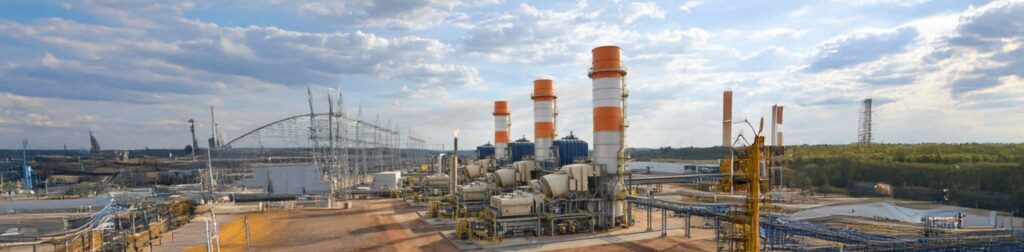
SCR Systems Engineered for Gas Turbine Performance and Compliance
Equipment Profile
Stationary gas turbines are deployed across power generation, oil and gas, and industrial applications in configurations ranging from small aeroderivative units to large frame-type machines.
They are used in simple cycle, combined cycle, and cogeneration configurations and are widely recognized as among the cleanest fossil fuel combustion sources per unit of energy output. However, their operating scale and annual hours make post-combustion NOx control necessary to meet modern permit requirements in most jurisdictions.
NOx Formation in Gas Turbines
Gas turbines generate NOx primarily through thermal mechanisms at the high temperatures occurring in the combustion zone. Modern dry low-NOx (DLN) combustion systems have significantly reduced turbine inlet NOx levels — typically to 9 to 25 ppmvd at 15% O2 — but permit conditions in ozone nonattainment areas now commonly require 2 to 5 ppmvd or lower, making selective catalytic reduction (SCR) the control technology of choice.
Key exhaust characteristics for gas turbine SCR design include exhaust temperatures typically ranging from 800°F to 1,100°F for simple-cycle units, high excess oxygen levels, and volumetric flow rates that scale significantly with turbine output and ambient conditions.
EcoCAT System Design Approach
- Detailed performance modeling using site-specific turbine exhaust data — temperature, flow rate, O2 concentration, and baseline NOx across the full load range
- Catalyst volume and layer configuration sized for target NOx outlet concentration and allowable ammonia slip
- Ammonia injection grid (AIG) designed for uniform reagent distribution across the full flue gas cross-section
- Aqueous or anhydrous ammonia reagent systems, direct-inject urea, or urea-to-ammonia conversion (AFCU) where site conditions require
- Controls integration with turbine DCS/SCADA for coordinated SCR operation across all load points, including startup and shutdown
- Reactor housings and catalyst frames designed for field installation on new or retrofit projects
HRSG Integration
For combined cycle applications, EcoCAT SCR systems are designed for installation within the HRSG duct, positioned at the optimal temperature window for catalyst activity. EcoCAT also provides HRSG engineering and supply as part of an integrated offering, ensuring system compatibility and eliminating interface risk between emissions control and heat recovery equipment.
Retrofit Considerations
Gas turbine SCR retrofits require careful evaluation of available space in the exhaust path, structural support for catalyst and AIG components, reagent system siting, and controls integration with existing turbine management systems. EcoCAT’s engineering team is experienced in managing these constraints to deliver retrofit solutions that minimize turbine downtime and disruption to plant operations.
Let’s Find the Right Solution for Your Facility
Every system is different—and the best solution starts with understanding your specific application.
Request a System Evaluation | Talk to an Emissions Specialist | Explore or SCR Solutions